Comparing Boo-Boos

I’ve been struggling with something for quite some time – the need for people to compare the severity of their injury to someone else’s injury and categorize it against each other – competing over who has the worse injury.

I liken this to the same phenomenon as soldiers from the Vietnam War telling soldiers from the Gulf War that those younger guys have no idea what it was like. That Vietnam was much more traumatic and violent and stressful than anything the soldiers from the Gulf War experienced. Not having been a soldier and not having ever been in any sort of situation where death and dying is occurring around me, I really cannot say. Yet, isn’t the fear of being shot at and hearing and feeling bullets zip past you the same? Isn’t the smell of dead bodies and blood, and rot and decay and death the same? How then, can the emotions of a surviving soldier be really so insurmountably different that they couldn’t share in each other’s grief, pain, even excitements and good memories from their respective combat experiences? Thus, creating a greater support structure for themselves and others.

Or, why can’t oppressed people’s come together and commiserate in a shared talking circle. While a white woman experiencing discrimination vs a black woman experiencing discrimination vs a Native American woman experiencing discrimination may each have a unique story to tell, wouldn’t their experiences and feelings of powerlessness, anger, frustration, and injustice be similar enough that these diverse women could come together and work together to fight it? Fighting for all oppressed peoples instead of just white, black, or Native American oppressed women.

What is it about human beings that we feel the need to compete, especially on matters that really should not be a competition at all? I have no answers and I know the answers are not easy. However, maybe that’s not true. Isn’t the answer the ability to put aside anger, fear, mistrust and misunderstanding and find a space to come together and start the conversations, however difficult and painful, to begin to work towards understanding, honesty, and trust? I know that in itself is extremely difficult.

One painful example of this in John’s life has been from his uncle, now passed. John’s uncle had his own set of debilitating illnesses and struggles. They would talk often, usually with the conversation turning to the uncle’s worries. After John’s injury, his uncle began to compete with him over the need to talk and over the severity of John’s injury. His uncle even went so far as to claim that he too had a TBI and began to parrot to John the same issues, symptoms and treatment strategies that John had been sharing with him. His uncle at one point even went so far as to stop John mid-conversation and say, “Enough about you, let’s talk about me.”

John is not one to complain, which is a good trait but also a bad one. He will not complain about an injury or ailment until it is really, really bad. As his wife, I’m left often times looking at him and saying, “Why didn’t you tell me this before?!” His response, “Well, I didn’t want to worry you.” Or, “well, I thought it would get better.” Or, even, “I didn’t want to dwell on not feeling well.” So, for John to go to his uncle as a place to vent and talk about his worries, was a big deal. The fact that he abused that trust was painful.

My issue with the comparing of boo-boos is not so much the want to try to meet someone to commiserate with, it’s more when it turns into a thing to compete over for attention and sympathy. This is offensive to both John and myself, as John works hard to not garner sympathy for his injuries or the impact they’ve had on his life. It’s frustrating when someone tries to use an injury that has been life altering for him as a way to try to get more attention for themselves, selfishly.

When John speaks with other people who have been injured, especially those with a TBI, he is sure to tell them that, while he can relate to their pains and struggles, he does not know what their TBI is like and does not know exactly what they are going through. I think this is a more positive way of interacting with other inquired people.


Attitude Adjustment

My husband has a hard time fitting into societal norms and maneuvering the nuances of societal niceties. He has a strong moral code that would be more fitting in a bygone time.

Any time John leaves the house, it’s a bet that he will return home with a story of someone who road raged on him, someone who said an inappropriate comment, or was generally inconsiderate or rude to him or someone in the general vicinity of his vision or hearing.

Ever since being honorably discharged from the Marines, he’s struggled to fit in with civilian life. He refers to himself as the “turd in the punch bowl” and it’s not a bad analogy. From what I have gathered, John would in fact fit in better with a Marine Corp infantry platoon than at a Walmart or family dinner party.

Apparently, this sort of behavior may be common in combat vets and maybe those with TBIs as well. At least that’s what we hear from John’s therapist. A large part of the reason John sees a therapist regularly is to learn how to manage his conduct in society. Especially now that he has a child, he doesn’t want to do something to embarrass her, may harm her, or cause her any sort of emotional stress due to his actions. It can be tough though. A case in point….

We recently took a family trip to Dinosaur National Monument. Overall, one of our most enjoyable trips yet. On day 2 of our excursion we went to the Quarry Exhibit Hall which, “allows visitors to view [a natural rock] wall of approximately 1,500 dinosaur bones….” At the base of this wall, visitors can touch dinosaur bones. There is at least one space on the wall where someone could start climbing this wall, using the bones as foot holds.

Family picture in front of dinosaur fossils
Eva, Me, and the allosaurus at Dinosaur National Monument, Utah.

Well, as Eva and I were posing for a picture in front of some Allosaurus bones, while John was across the hall closest to the wall of exposed bones, an 8 year old boy came sauntering up, nearly bumping into John (I think John even had to scoot out of the way a bit), and began to try to climb the wall. It was an affront in many ways. Not only was it horrifying to watch this kid possibly damage property but his nonverbal mannerisms were extremely off putting, almost aggressive, and a generally “what are you going to do about it” vibe. I could tell all this from about 12 feet away and also because of a brief encounter I’d had with him earlier. John told the boy to not climb on the wall and the kid smarted back, “Who’s going to stop me?” John said something about going to jail for damaging property and the boy retorted with, “They won’t send me to Juvie for that.” John was taken aback, his blood pressure rising. John ended up asking him how he knew about Juvie and asked how old he was. Based on an even snarkier response from the kid, John proceeded to tell him that he was a retired cop and that we were in a National Park, meaning the rules of the game were Federal. It progressed further in a lecture that was brutally honest about things that happen to people who go to prison. The kid quickly left, presumably high tailing it back to his parents. God knows where they were through this entire thing, not even being aware their kid was being so destructive and rude.

John ended up telling the nearest park ranger about the incident, in the event she received a complaint from the kid’s parents. John later expressed his concern to me that it wasn’t so much what the kid said but how he said it and that he was already gaming the system and considering the cost vs reward of a crime or misbehavior. I rationalized with John that maybe boys that age are generally destructive and wanting to push boundaries. He agreed but reiterated what he’d said before. We both commiserated that if either one of us had behaved like that or spoke to an adult like that when we were kids that we would have been reprimanded severely.

This incident was unusual in that it was with a child but it’s a good example of the interactions he has almost every time he goes out. John functions off a different code of conduct than, seemingly, a large segment of the population. Often, John is severely offended and often feels disrespected when things happen that the rest of us tend to blow off or maybe gnash our teeth, say a bad word in the offenders general direction, and go about our day. John has a hard time letting these things go and I think his TBI impacts that.

Survivor’s Guilt

I am a member of a couple of support groups on social media that are meant for survivors of TBIs and their loved ones. These groups are useful but, as when I read books written by or about someone else who has had a brain injury, the other members are almost always dealing with things that John and I are not and have not. It creates a sort of survivor’s guilt for me and a sense of, who am I to write about my life when a lot of other people have it much worse with their partner? However, I am also bolstered by the feeling that there are a lot of spouses out there that may be feeling like me and maybe don’t feel like they have a place to commiserate.

John was diagnosed with a mild traumatic brain injury (MBTI). I wish the doctors would change the name “mild” because, to us, it’s anything but mild. It comes down to the use of language. Others hear “mild” and automatically discount it.

Northwestern University has a clear definition of the differences: (cited from https://bouve.northeastern.edu/nutraumaticbraininjury/what-is-tbi/severity-of-tbi/ on 11/9/2020.)

Mild, Moderate, and Severe TBI

“Traumatic brain injury severity is commonly described as mild, moderate, or severe. Injury severity is traditionally based on duration of loss of consciousness and/or coma rating scale or score, post-traumatic amnesia (PTA), and brain imaging results. Mild, moderate, and severe TBI may be characterized as follows:

  • Mild TBI
    • Brief loss of consciousness, usually a few seconds or minutes
    • PTA for less than 1 hour of the TBI
    • Normal brain imaging results
  • Moderate TBI
    • Loss of consciousness for 1 – 24 hours
    • PTA for 1 – 24 hours of the TBI
    • Abnormal brain imaging results
  • Severe TBI
    • Loss of consciousness or coma for more than 24 hours
    • PTA for more than 24 hours of the TBI
    • Abnormal brain imaging results

Severe TBI may be further sub-categorized as follows:

  1. Coma- a state of unconsciousness from which the individual cannot be awakened
  2. Vegetative State- a state in which an individual is not in a coma (i.e. awake) but is not aware of the environment
  3. Persistent Vegetative State- a vegetative state that has lasted for more than a month
  4. Minimally Responsive State- a state in which a person with a severe TBI is no longer in a coma or vegetative state and inconsistently interacts with/responds to the environment.”

Personally, it is tough for me to share my experiences, both good and bad, with someone who is dealing with a spouse who is incontinent, has seizures, had a major personality change, is aggressive or mean, is bound to a wheelchair and so on. Thank the powers that be that John has not had those things. Yet, what happened to him has been radically life changing for both of us and continues to be.

I hope others who might be feeling similar to me read this blog and feel like they have a place to share, be heard, or at least can read about someone who’s life sounds familiar to their own. Hopefully I can move past this survivor’s guilt that I have sometimes.

Breathing Freely

A couple of years ago, we made a life changing decision to move away from a busy, sprawling city with millions of people to a smaller town of 50,000. It meant uprooting a life built over more than a decade. It was not a decision made lightly. However, it was one of the best decisions we have ever made.

John, Eva, and I are all so much happier. We don’t spend nearly as much time sitting in traffic trying to go to the grocery store or on a family outing. We don’t have to worry as much about a local lake or swim beach being packed by people so that we have to wait hours to launch a boat or have a relaxing family time.

All of us responded positively to less people and the hustle-and-bustle. There is a general heavy weight or angst that we experienced when living in a city and with lots and lots of people. In a real sense the ability to move at a slower pace, be less bombarded by advertising and marketing to buy-buy-buy, and less competition is palpable and truly feels as if a great weight has been lifted off our shoulders.

For John, I think this change has really been life changing. With the TBI and PTSD, he can more easily navigate daily life. With his limited amount of time before he starts having a fuzzy or bad brain day, he can get more accomplished. Where we were living, he would spend an hour slogging through traffic and chaos before getting to his doctor’s appointment or store, or fishing spot. He’d be exhausted by the time he arrived, making the outing a tremendous burden that had ramifications that trickled down to all aspects of his life and well being.

Now, he still gets tired and sometimes has to modify his to-do list for a given outing but he usually can get what he wants accomplished without it wiping him out. And this is helpful for the rest of us.

We were lucky enough to be able to make this move to a more rural area. I urge other couples to try to make as many changes as possible to slow down and simplify their own lives. It will make all involved more at peace and better able to deal with the ramifications of having a TBI.

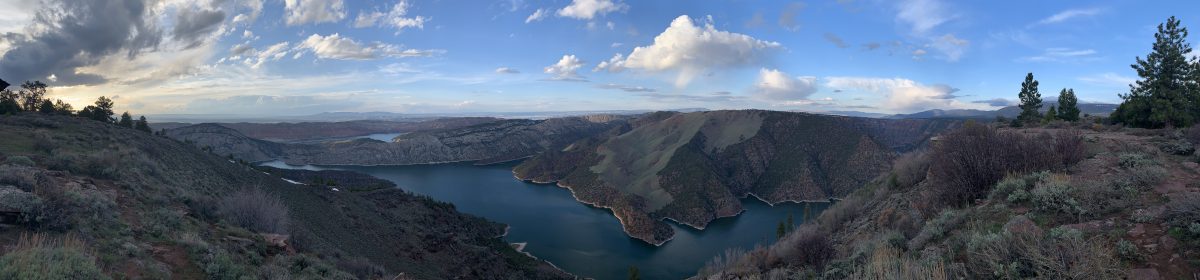
View outside the house this morning.

For the Love of Music

It is late. It is a weekday. My daughter is asleep. My husband has just left on an extended fishing trip. I’m tired but don’t want to go to sleep because it’s too nice to have these moments of time when I have a quiet house and, other than the fact that I have to be a productive mom and employee tomorrow, I am free to do as I wish. I love my life and family but, wow, these times when I can recall and revisit the piece of me that I rarely have time to explore anymore (the me when I was freer and learning all about myself and life) are so, so needed. I am grateful for these moments when I am given time to reconnect with that piece of myself.

I have spent some of my evening reading a guilty pleasure, Midnight Sun, the latest Twilight Saga, by Stephenie Meyer. I spent the other piece starting to watch, “No Direction Home: Bob Dylan” by Martin Scorsese. It’s a long documentary about Bob Dylan. It includes snippets of amazing music from other musicians too, such as Odetta, Woody Guthrie, and Betty Davis. I have always loved music, especially blues, country, and rock ‘n roll. All sorts of other genres too but those are my go-to’s. Dylan is up there with one of my favorite song writers. I know his story but always find learning about him, his journey, and the pivotal point in history when he was coming into his own fascinating.

As I was listening to and watching this documentary, I was reminded of just how much I enjoy listening to music. It’s not something I forgot about myself by any means but it’s something I’ve had to modify or adapt to my current life. As I reflect on this more, I am a little melancholy that I cannot have music playing in the house very often anymore, especially at a volume louder than to only be heard a few steps away. I can and do occasionally, especially when I’m cleaning or cooking (as a distraction and as a joy, respectively) play music. When I’m cleaning I tend towards 80s playlists. When cooking, it’s typically blues, Fleetwood Mac, or a 50s/early 60s rock ‘n roll playlist like Fats Domino and Ben E. King.

Generally what happens is I get through a song or two, maybe 3 or 4, and either Eva or John walk in. I’ll be mid-chop, dicing a bell pepper, tapping into my inner Julia Child, hips swaying to the tune, humming along (no one wants to hear my singing), and have to turn it down or off. For Eva, it’s usually because she wants to talk or show me something or help me in the kitchen, all of which take attention and music can become a distraction. For John, it’s because he’s just woken up, wants to talk, or the like and the music is a major interruption to his thought process and the health of his brain. At times, I can get away with playing it for longer though and it’s a pure joy. I swear my cooking improves because of it. I can more easily pour my love into the meal.

This is one aspect of something I really enjoy and honestly have a deep down yearning for that I have learned to be adaptable with. I can put my earbuds in, I can turn the music down, I can pause it until my attention is no longer required, I can jam out in the car later or on my morning run (although that is typically time I devote to my audiobooks), or I can turn it off and know it will be there for me when the time is right, such as on this lovely evening.

Before ending, I also feel compelled to mention that, because of John’s TBI, he can no longer listen to certain types of music. This includes anything that doesn’t have a distinct rhythm, such as jazz or funk. Fortunately, these are not my favorites. Yet, this is something I consider when playing any of my music when John is in hearing range. Certain types of music will instantly launch him into a fuzzy or even bad brain day. I am always gauging his body language and facial expressions while music is playing. I will respond immediately and without comment if I notice a slight twinge from him by turning the music off or lowering the volume. Sometimes something as simple as going to the next song is enough to keep the balance. Often this occurs without him even noticing, which is great. I don’t want John to feel bad about me having to change my behavior to fit into his TBI world. He feels guilty enough about it. While music is important to me, it’s something I can adapt.

As always, please comment, share, or ask questions.

Self Care

The dreaded topic of self care, maybe the hardest thing to find time to do. I am unsure if a characteristic such as being a minimizer is typical of a caretaker. For me, it is very much the case. By minimizer, I mean that I constantly downplay my role and the impact my help has for John and my family, and the impact all the extra things I do have on me.

With this post, I want to start diving into my emotions more on this blog and the things I do to help myself stay sane and healthy. One person in our family with major health problems is enough! Self care is imperative for a caretaker. It’s also one of the hardest things to do.

Things I do when I need time for myself:

  • Journal – this helps me to organize my thoughts, vent, and often helps me make a decision
  • Read – I am an avid reader. I read fiction and nonfiction. I love finding a book (paper book, ebook, or audiobook) that I can sink into and go somewhere else for a little while.
  • Workout – I try to workout for 30-60 minutes at least 4 times a week. It’s not something I really enjoy but it helps keep me active and healthy.
  • Get a treat – okay, the juxtaposition of healthy. There are times a candy bar or an ice cream fills the gap.
  • Go for a short walk – usually this happens on a break at work and I don’t do this enough but I always find it useful and refreshing.
  • Tell myself to take it easy, to slow down, to not overdo it. This is so hard to do. Sometimes I work myself into a frenzy and then can’t concentrate on anything and start acting an awful lot like a chicken with my head cut off. When I catch myself doing this I stop, take a deep breath, and focus.

I also cannot say enough how valuable a therapist is. I find that someone who is a social worker or therapist instead of a psychiatrist is most useful for me. I currently don’t have a therapist but I’ve been thinking recently that I need one again. I have gone to a therapist three times before. I find the process of sitting before a therapist and venting all my worries, frustrations and fears to this person for an hour has the same effect that getting a massage has. I feel incredibly relaxed afterwards. The relief of the carried stress is tremendous.

I like to go to a therapist instead of venting to a friend because a therapist is an impartial person. They will not side with me just because they are my friend. There are also times when I have an awful lot to get off my chest and I don’t like burdening a friend with all that.

You Look Just Fine to Me

There are a few common phrases John and I hear when we are explaining John’s TBI to others. These solicit varying levels of irritation from us although I think this is rarely perceived. I know that the person saying them is trying to ease an embarrassing situation, trying to make light of it, trying to make John feel better, trying to make themselves feel better, or, maybe at times trying to minimize his injury. I really try to find the goodness in others and hope that most of the time, it’s not meant maliciously. Here are a few:

  • “You seem fine to me.”
  • “I forget things all the time too.”
  • “Welcome to my world.”
  • “Well, you look healthy.”
  • “Maybe you’re just getting old.”

Pondering on past experiences, I am reminded most readily of interactions with neighbors saying things like this. John will use his forgetfulness of names as a way to try to explain his injury. He does this not to bring the attention to him, as he would much rather not have a brain injury but rather to try to let the neighbor know that he isn’t being rude or un-neighborly but he really doesn’t remember and has a very hard time remembering because of short term memory loss. He may say, upon meeting someone for the first time, especially if we may need to speak with them again, is, “My name is John. It is nice to meet you. Please forgive me if I call you sir/ma’am or if it takes me awhile to learn your name. Because I am brain damaged, I have a hard time remembering names.” This often results in a slightly embarrassed, socially awkward response of, “Well, I forget names all the time too.” Or, “Okay, well, you can call me ‘hey you’ if you want.” Being a witness to this exchange is awkward. I’m left with a feeling of wanting to defend John and wanting to make the person feel better about it.

It is these fleeting yet frequent moments that eat away at the armor. I know they irritate John. They irritate me too. I know people feel compelled to say something, similar to the dreaded phrase, “I’m sorry for your loss.” Or, “I know how you feel.” Why do we, as humans (or maybe it is cultural) feel the need to say something? Silence is okay sometimes or a simple “okay.” Or, “Thank you for telling me.”

It gets tiring feeling like I need to be aware of other people’s emotions too. It gets tiring hearing x phrase, wanting to say something biting back, then quickly realizing they just don’t get it, and just as quickly letting it go. Why must John or I also take on the burden of their emotional care as well as everything else?

There is another layer to this too. John’s injuries are invisible. There are times we vent that it would be easier, socially, if he were missing his leg or something like that, something visible. Something that would make others see that he is injured, that there may be times when he needs accommodations or a break. As I write this, I also am aware that if his injuries were visible, it would probably get just as old to be constantly catered to and assumed help. Sigh…is this all just part of the human condition?

As always, I appreciate comments, questions, feedback.

Little Things

In my last post, “TBI Moment = Birthday Bliss,” I wrote about forgetfulness. Over the past week, I have ruminated on the other ways forgetfulness impacts my life, and John’s of course. By extension, I think most other caretakers will be able to relate.

Just yesterday, I went into the kitchen and saw that the milk had been left on the counter. John had forgotten to put it away. This time, I caught it before it spoiled and half a gallon of milk had to be tossed. I could go on about other times I have found the eggs in the cabinet with the plates or the ice cream in the cooler.

Sometimes it gets tiring being the keeper of all things in the house. And the declutter’er. A constant question from both my daughter and husband is, “Do you know where the ______ is?” What’s really annoying is that I generally do know and in explicit detail.

John is perpetually leaving coffee cups all over the place. He forgets they are on the bedside table or the bathroom counter or by the gym equipment. He leaves water bottles in his car and wonders later why we always run out or can’t find them. This usually ends in his buying of more reusable water bottles. It’s such a waste. He also blames others for the loss of things. Sometimes this blame is justified. We do have a 5 yr old who likes to collect things like a raccoon and secret them away. Or, I do get lazy and borrow a screwdriver without returning it to the toolbox. But, at other times it is no one else’s fault.

Tonight, he was on his way out the door. He wanted beans as a side for dinner and got the InstaPot going before he left. By the time we were sitting down for dinner, he realized that we couldn’t have beans because he had forgotten to put the beans in the pot. He had pressure cooked chicken broth. He admitted he was trying to multitask at the time he was cooking. Never a good idea. We laughed it off. We will have beans tomorrow.

There are times when it’s frightening. It is usually my responsibility to pick up Eva from daycare. Occasionally, John will get her though. This usually happens as a surprise with John calling me mid-day and letting me know. So, it is out of the routine. I will usually text or call John on my way home to ensure he has remembered to do this. He hasn’t ever forgotten but it’s always something I worry about. There are times when I don’t call to check, drive all the way home and then ask if he has remembered. He will tease me and act like he forgot. It never fails to raise my blood pressure and for a few seconds launch into total go mode. I finally told him the other day how much I hate it when he teases about it. I’m hoping he won’t do it again.

He said something endearing the other night that goes a long way in making it all tolerable. He had first lost his soda but found it. Thirty minutes later he lost his phone. I smirked about it and mentioned that he was more forgetful than normal. He said, “That’s why I spoil you so much. I know if I lose you; you’ll come back to me.” My sweetheart. Come to find out, he’d left his phone on top of the laptop which I had moved en masse without really being aware of everything I was moving. We’d found it but it was irritating to be blamed when I had been trying to be helpful by moving it all.

My job in all this is to try to pick up the slack and to not get too frustrated if things are missed or plans need to be altered. I often self-talk and say, “Self, this isn’t a big deal. Don’t sweat the small things.” Most of the time, at least at this point, his forgetfulness is of little things.

TBI Moment = Birthday Bliss

A telltale sign of a TBI is forgetfulness. This leaves the caretaker with the added responsibility of not only remembering their own to do list but that of their TBI loved one as well. Thank heavens for smart phones, calendars, timers, and whiteboards – am I right?

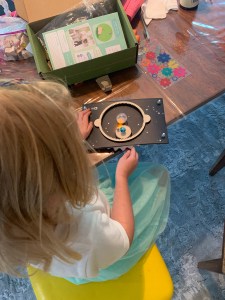
Tonight after dinner, Eva and I were putting together a newly arrived KiwiCo project. (An amazing STEM based company by the way.) We were in our bedroom. John was unwinding, laying down on the bed viewing his iPad. We were doing our own things but occasionally interacting.

John got my attention and said to me, “Well, I had a TBI moment and accidentally bought you more birthday presents than I had intended.” My response, “Well, okay. Yay for me!” (Only just slightly kidding on my response.)

Come to find out, he’d purchased a gift last week in preparation for my upcoming birthday. Then, he went on a fishing and camping trip. Eva and I joined him for the weekend and we got home late Sunday night. We all had a great time. On Sunday, our last day there, we spent too long on the water. We had meant to set the timer so that we would have time to put the boat away and still give John his rest time before the drive home; but, John had forgotten and I thought he’d done so. It was 2 hours past his rest time by the time we were ready to hit the road. Eva and I left after John assured me he would be driving to the next town and then pulling over to rest in the camper before finishing his drive home. About an hour away from home (the lake being 3.5 hours away) I figured it was okay to call him, thinking he would be up from his nap by then. Well, come to find out he skipped a nap, took a Modafinil, and was actually ahead of us because Eva and I had stopped for some dinner. Needless to say, he was exhausted when he got home.

The next day, he got Eva to daycare and made it to a doctor’s appointment then came home and flopped, ending up sleeping for 4 hours. As he returned to bed after dinner he said in an exasperated tone, “I’m still trying to wake up!” He looked bone tired. I was not surprised by his need for sleep and rest and limited energy but he was. This is a common thing. The person with a TBI often believes they can get up and have a day like they had pre-injury. Being shocked, depressed, and sometimes angry when they can’t and crash and burn instead. It is a brutal reminder to the person with a TBI that, yes, they are still injured. As John says, “It’s the gift that just keeps on giving.”

To get back to my story, because of the lack of sleep and disruption to his routine, John had forgotten that he had already bought a gift for me and bought another. At least this time he didn’t double buy the same gift, which happened at Christmas last year. I suggested after he told me of his “TBI moment” that he should save the extra birthday gift as a Christmas gift instead. He shrugged in a dismissive sort of way.

He will likely give me both gifts for my birthday. Not that I’m complaining. He has a point though. If he tries to save them, by the time December arrives, he will have not only forgotten he bought those gifts; but worse, where he hid them.

Completed KiwiCo activity with Eva. It is a model of the sun, with the Earth and moon on a wheel so that they rotate around the sun when turned.

Raising Eva

I have been asked before how our daughter, Eva, who is almost 5 years old, handles all of her dad’s TBI related issues. The short answer is that she handles it fine because to her, this is normal. She does not yet know that not all families have injuries to deal with. I do not even really know what life would be like without an injured husband who is parenting with me.

Even though Eva doesn’t realize anything is different about her home life compared to others, John and I do. We work hard to make conscious decisions about her upbringing.

Last weekend, John took Eva to the beach (giving me a few hours of much needed alone time). They’d been there for awhile when a family arrived and setup their stuff directly in front of Eva and John. It was so bad that Eva could no longer swim there because of their oversized float. It was quite rude of them. (See image) Eva turned to John and said, “Dad, are you getting angry? Are you mad?” John replied that he was a bit annoyed but that she could still swim. She said, “No, I don’t like those people and I’m hungry. I’ve been swimming enough.” That ended that. They had been swimming for a couple of hours by that point so she was likely ready to eat and leave. I think the interchange was interesting though – that she was astute enough to pick up on the subtleties of the situation. She may be picking up some of my behaviors when I step in to deescalate a situation before it even begins to escalate for John.

Oversized float directly in front of John and Eva’s slice of beach.

We regularly talk with Eva about her behavior in relation to John. That when she needs to be quiet around the house or even at times when John snaps and may deal with a situation a little on the harsh side, that it isn’t Eva’s fault. That she hasn’t done anything wrong. (This is only in those cases when she hasn’t in fact done something wrong. She is punished if she oversteps her boundaries.) That daddy has a brain injury so sometimes needs to rest or needs quiet. An example is when we are out at a restaurant, like Chick-fil-A, and the noise or lights get to be too much for John and we have to leave sooner than we’d like. At a place like that Eva is typically playing in the playground area so it is a major let down for her if we have to leave sooner than expected. She knows not to throw a fit but will pout. Once we are in the car, we will explain it to her. It’s still a bummer for her but she understands that it’s what we have to do for dad and it isn’t her fault.

She is a very caring little girl and often wants to contribute and help. I wonder if maybe she will go into healthcare or some other field where she can care for others. Time will tell. Right now she says she wants to be either a doctor or a “firefighter doctor” when she grows up. She may be so tired of living with someone who is injured that she may decide a career like that will be too close to home.

Our end goal with her is to raise a happy and healthy person who thinks before acting. We are doing our best to try to ensure she doesn’t form any enabling characteristics or have a stigma to overcome personally. We are honest and open with her.

Some good things are that we do a lot of family things together. She is included in the team and has a say in many things. Because John is retired and I work M-F, 8-5, him and her get daddy/daughter time every morning. They snuggle together as Eva is waking up, they have breakfast together, John plays good music for Eva and they sing together, etc. For instance, Eva now sings lyrics from The Animals, “House of the Rising Sun.” This one-on-one time with her dad is unique and something she would miss out on if he were working like me.

The routine John has to follow requires all of us to follow. This is annoying but also a good thing. It forces all of us to take time to rest and slow down each day. The routine and structure is excellent for Eva.

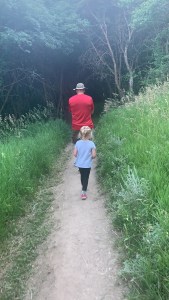
On a small hike nearby our home.

I would love to hear from you. Please comment or leave a question.