What the Flock

I have another story to share, this one about impulsivity, not great planning skills, and stubbornness.

About a month ago we bought some chickens. We got them as started pullets. We have a small flock of four. They are doing well. It’s been fun for us all watching their behavior and waiting as they get big enough to start laying.

Enjoying it so much and being concerned about predators, John landed upon getting a guard goose. Apparently, a goose or two make incredible mates (friends) and alert systems/protectors of the chickens. Geese have attitude and will honk a great deal, make themselves as big as possible, and charge anything they think of as a threat including hawks. We have a nested pair in a large pine next to our house so this is a concern. As long as we hand raise goslings, they should accept us as their own and be more affectionate with us. At the minimum, they should not treat us as predators and come charging us, most of the time. Ha!

So, John had been discussing this with me…the prospect of getting a goose. We’d decided upon it but had also decided to hold off until we could spend this summer getting a larger coop setup and get a year of chicken ownership under our belts. We were also having a hard time finding geese to buy. Then, late one night, a couple of weeks ago, after John had partaken in his evening dose of medical marijuana, he was laying down in our bedroom and found a site that was selling day old goslings. They’d ship within 48-hours of purchase. I was in our en suite getting ready for bed and having this conversation with him about if we should get them, when they’d arrive, if this worked with our plans, and the logistics of getting geared up for brooding baby geese. While I was strongly leaning toward saying yes, we had not yet done so. I was still saying something about the pros and cons when I came around into the bedroom and he said, “I just bought them.” I didn’t get upset but was kind of flabbergasted at the turn of events. It quickly turned into questions of when do they get here, what do we need to do to get ready, what will we do when we are on vacation for four days (which would have been only a few days after their arrival). He assured me he’d take care of it and it would work out. (Well, it always does work out, doesn’t it, but getting there is the issue.)

They were to arrive on a Wednesday. When we hadn’t received a shipping confirmation or the goslings, we called and learned that Tractor Supply, where we purchased them, had no record of the order. John got home that night and ordered two more goslings from a different company, to arrive in mid-June. This time that decision was still impulsive but better thought through because there were only two and the type we both preferred having, unlike the order of ten. We thought that was that. Yet, when I asked John if he had received a confirmation that the Tractor Supply order had been cancelled he said no. I didn’t press the matter but I suppose he pondered that overnight and the next morning, called the breeder who was working with Tractor Supply. They informed John that they had his order and the ten goslings had not shipped yet because they hadn’t yet hatched and they wouldn’t ship until a couple of weeks later. We attempted to cancel the order but couldn’t due to an administrative error between the companies.

So, we now have 12 goslings coming!! We can’t possibly have 12 so we plan to sell or eat all but two.

This situation may have happened to anyone but I think we find ourselves in it due to John’s lack of executive functioning skills — impulsive purchases, impatience, and stubbornness at making something happen when sitting back and waiting for a moment would have been the better choice. He ended up spending a lot more than he would have if he’d have waited. And, now, he’s complaining of feeling overwhelmed and he’s nearly symptomatic again because of all the things he’s juggling (things other than the goslings that he has initiated in the past two weeks.)

I think this is a perfect example of my flexibility and roll with it sort of attitude. It comes in handy in these situations. Yet, I wish I could look at him when he complains of being exhausted and overwhelmed and frustrated at not being able to find the time to do his chores (such as organizing the garage, which has been a couple of year pending thing) and say, “Well, could you hold off making any more purchases that create more work for us and more clutter until you get that other stuff done?”

His current conundrum is totally self-created. And, one that I am having to help juggle to keep everything afloat.
Career Change

I’m going to just come out and say it. I have decided to become a registered nurse!! Yes, at near the age of 40 and 14 years into a career as an office/project manager. After having completed a master’s in history, being married and with a young child I am returning to school to complete a bachelor’s of science with an RN. I am both really nervous and really excited.

As you might imagine, I landed on this decision after a fair amount of soul searching. It came about for a couple of reasons. I have been, let’s suffice it to say, not the happiest at work and cannot see a future for myself with my current company after trying a number of ways to progress. I also am not inclined to try to find a different company to work for, doing a similar thing. John has been going crazy the past few years watching me so unhappy at work and late last year looked at me one night in the kitchen, and said, “Have you ever considered nursing?” I looked at him all gap jawed and wide eyed and said, “No. Are you out of your mind?” He said no and proceeded to explain his rationale. He has seen my personality and the way I have taken care of him over the years. He also said that he’s seen the way I am with our daughter, kind and gentle yet tough and firm. An example, she had scrapped her knuckle. I was in the bathroom with her, trying to clean it out and get a bandaid on it. She didn’t want me to run it under the water and gently try to work out the gravel and dirt in it. I had her hand in a firm grip as she was fussing and crying and said to her, “Sweetie, I know it hurts but we have to clean the cut out. This just has to be done.” John said he was witness to this exchange and realized that I’d make a great nurse. Further, knowing me so well, had an inclination that I would enjoy it. I told John that he had a point but that my taking care of him and Eva did not equal taking care of other people. As we continued to talk though, I started to see his points and give some water to a tiny, itsy-bitsy seed that had been lying dormant in the shady recesses of my mind.

I have taken care of John and hopefully well. What I now recognize as tiny seeds were planted by the interactions with doctor’s and nurses and therapists who have treated him. I also recognize seeds that popped up during my reading of health related things. I have thought before that if I could do it all over again that I’d like to go into medicine of some sort. I actually had a conversation with John’s occupational health provider about the path I might take to do what she did. I also had a previous boss who would say, “what we’re doing is important but it isn’t life threatening.” Each time she’d say this I’d usually briefly think about how neat it would be to have a job where what you did all day did make a difference and might be life threatening or life altering for someone.

I never pursued these thoughts deeper because I didn’t think I could because of a lack of capability and I thought it was too late for me.

I was not good at math. This held me back from taking classes in the hard sciences because there were math prerequisites that I couldn’t get past. So, even though I loved the one Biology class I took back in high school, I couldn’t complete the second class because my teacher wouldn’t sign off on my progressing unless I had better math scores. As I got older and into college, I decided to complete my science credits by taking geology, an avoidance tactic. By that point, biology or chemistry seemed like subjects beyond my grasp. Over years of crying over my math homework at night because I was so frustrated at not understanding it and just eking by in math, I had and have a lot of hang-ups with perceived lack of ability.

Since late last year and after I thought hard about this nursing idea, I knew I was going to have to face my demons and determine if I could relearn math and get into the hard sciences. I also knew I would need to pass the nursing school entrance exam. I signed up for a general chemistry class to see how I would do in the subject. I also began to work my way through re-teaching myself math. I literally began with 7th grade level concepts in pre-algebra. I also found a YouTube channel to get a crash course in anatomy and physiology. And, I found a little cadres of friends who were willing to tutor me or give me mini-lessons in key topics. And, I used a Kaplan study guide. I have to give credit to The Khan Academy, Brandon Craft Math, and Science with Suzanna for getting me to a level where I not only passed the entrance exam but did well. The chemistry class I not only did pretty well in but really geeked out on learning about the subject. I have been overwhelmed by the generosity of time and support I’ve already received to make this dream a reality.

I will begin nursing school in September. I know the next few years are going to be intense and difficult but I now have confidence that I can do this. That those subjects I once thought out of reach, are not so unattainable. I am also really excited about finishing out my life working as a nurse. I think it will be rewarding in ways I don’t yet realize.

We will see where I end up but this is a silver lining to my husband’s injuries. If it weren’t for him and what he’s gone through, and we’ve gone through together, I’m not sure I would have gotten here mentally or been in a position to do so. It’s because of him and his sacrifices, and his constant cheerleader encouragement of me, that is allowing me to have this option.

In talking about this career change with other people, I’ve heard many stories that what I’m doing actually isn’t that unheard of. Many people know of friends or colleagues who were mid-life and mid-career but decided to become an RN or go to medical school. I’m not sure I was emotionally ready or mature enough when I was younger to land on healthcare. As long as I can study my tail off the next few years, I should be working as an RN. Ahhh!!! It’s totally insane but so very invigorating all at the same time!

Nothing Comes for Free

Does anyone else here have to deal with Veteran’s Affairs (VA)? I’m beyond grateful for the benefits they offer as John, myself, and Eva have or will benefit because of John’s service. However, the saying, “nothing comes for free” applies.

I could go on-and-on about the long, expensive and hard won battles with the VA that John has fought over the last decade. I could also go on-and-on about the monthly, continuous battles John deals with. Here, I’m going to speak of two. The first is about the COVID vaccine. The second is about the ability, or maybe inability is a better use of language, to get medications.

First, the vaccine, John has been wondering if he should go to the VA for his vaccine or the local health department. With his pre-existing conditions, he also thought that perhaps he might receive the vaccine a little sooner than someone else his age who is reasonably healthier. He has checked many times on the VA site and by calling and was told, by a recorded message, that the VA is offering the vaccine to only those 65 and older. It’s been like this for weeks.

This week, he was on the phone with the Congressional Liaisons Officer, about the second matter, which I will address shortly. At the end of the conversation, John asked if he knew if he should plan to receive his vaccine from the VA or the local health department. The liaison officer paused for a moment and asked, “You haven’t received your shot yet?” John said no. The liaison asked, “Has anyone contacted you about getting it?” John said no. “And you want it?” John said yes. This is when we learned that, apparently, the VA has been offering a large portion of their vaccines to the local general health departments to be distributed and have been for some time now. They claim that no more veterans want to take the shot. That they have offered it to all of them. In our case, this is a bald faced lie. For us, we shouldn’t be surprised because this is pretty much how we’ve learned the VA operates. It’s infuriating.

The liaison officer told John to call, wait through the message to speak to a human, and get scheduled for the vaccine. When John called, he once again heard the prerecorded message that the VA was still only accepting those 65 or older. He waited this time until someone answered. He told the person that the liaison officer told him to call and that some of his medical conditions might give him access to a shot sooner. The person told John, “Oh, you don’t have to worry about any of that anymore. It’s been open for 3 weeks now.” John was scheduled for a shot on Monday. Bureaucracy at its best.

The second major issue is the constant, full-time job worth amount of time John spends on the phone every week between his doctor’s offices, the VA pharmacy, the Community Care Center (CCC), and TriWest (a contracted company the VA uses that is supposed to help). At the risk of drowning you, my dear reader, I feel compelled to share with you just one example of an experience John regularly deals with in managing his care. The below is one example but it’s like this every time he goes to see any of his doctors (GI, primary care physician, neurologist, and a number of other specialists). He has 4 regular doctors and 7 regular medications he takes.

Calendar Outline:

  • 2/2/21 – John sees his GI doctor. At the appointment, he reminds the scheduler to check his verification for his medication. If it’s expired, to please fax an updated one to the Community Care Center (CCC).
  • He gives this a reasonable amount of time to get accomplished.
  • 2/7/21 – John checks e-Benefits (the VA system where he can track his medications and files). His medications have not posted. This is the trigger to let him know that he needs to start calling to track things down.
  • 2/8/21 – He double checked e-Benefits and still hasn’t seen his meds. He calls the VA pharmacy, spent 15-min. on hold, and spoke with someone who was unwilling to give him their name or identifying information. After asking them to check on his medications, they put him on hold, and he was disconnected. He called back and got a different voice who still didn’t identify herself but told him the prescription was there and waiting but they didn’t have an authorization number yet so could not release it.
  • 2/8/21 – John called the GI doctor’s office. He asked for them to send the verification to the CCC. This started a verbal confrontation with the person on the other end of the call. She was adamant that she’d sent the authorization. She finally verified the number she sent it to, which, come to find out, she’d faxed to TriWest. In a perfect world, that is what is supposed to happen but John had asked her to fax it to CCC because of bad experiences with TriWest. TriWest had received the fax but could not find it now. She finally agreed to send the new request to the CCC.
  • 2/11/21 – John called the CCC. He was on hold for 45-min. before a recorded voice announced that they were experiencing technical difficulties and to please call back later. The call was disconnected. John waits 2 hours and calls back. This time waiting 35-min. before the same thing occurred. John decided to call back another day.
  • 2/12/21 – John called the CCC again. He spent 45-min. on hold before finally getting an answer from an irate employee. She verified that they did receive the request from the hospital and that it was now waiting to be approved by a nurse. John explained that he was going to run out of medication (not a good thing as it could send him into a relapse with his ulcerative colitis. If that occurs, he spends time in the hospital and nearly dies from blood loss). Since it seemed like it was going to take time, he asked if he could pay out of pocket for the medication (a few hundred dollars) but get confirmation that he would be paid back by CCC. The woman told him she didn’t know and “I just can’t help you.”
  • 2/17/21 – John checked e-Benefits again. His meds are not there. He called the VA pharmacy again to check. They informed him that they had not yet received the authorization number. John then called the CCC again, was on hold for another 45-minutes, and disconnected. He then called TriWest. They answered the phone and he asked if they received the re-authorization numbers. The reply was, “I don’t know.” John prodded her to look. She put him on hold and he got disconnected. At this point, John is frazzled so he takes a break.
  • 2/19/21 – John called CCC again and waited for 30-minutes. He finally got to talk with someone. This woman was extremely helpful and polite. She was able to tell him where his referral was in the process and that everything should go through by Monday (2/22).
  • 2/24/21 – John looked at his e-Benefits and it’s still not there. He called CCC three more times with the same above mentioned wait times and disconnections.
  • At this point, John is reaching a state of dread at calling anyone anymore. He’s frustrated and broken down. He doesn’t want to call or deal with this. He just wants his medication.
  • 3/1/21 – Still no changes to e-Benefits. He calls back to the CCC and gets someone who is customer service oriented. John explains his situation to this man and the guy takes the time to read John’s notes, which are numerous. He also ensures that John has his name and number in case they get disconnected. John is on hold for 30-min. and they are disconnected but 10 min. later the guy called John back and told him that he didn’t know what was going on. That a nurse approved it but the office in Montana decided that John needed to do a tela-health appoint with a VA doctor about the medications. (Someone other than his current GI doctor.) John asks why the VA is changing his continuity of care without asking him, where his meds are, and how is he supposed to get his meds. The employee apologized profusely and referenced John to call his Congressional Liaison Officer, whom John has on speed dial at this point, which is just sad.
  • 3/1/21 – John left a message with the Liaison Officer.
  • 3/2/21 – The Liaison Officer called John back letting John know he’d sent emails to all the department heads related to this and that they should be contacting John by the end of the day.
  • 3/5/21 – John hasn’t heard anything from anyone. Just as he’s calling the Liaison’s Officer back, he gets a call from someone who does not identify himself but tells John that he has refilled all his medications and sent them to the central distribution center which may take several weeks before arriving to John. Then, he hung up.
  • 3/9/21 – John checked e-Benefits again. Still no changes. He called the Liaison’s Officer again and explained the entire situation. He promised John that he would have a phone call that day. 30 min. later John gets a call from the supervisor of the VA pharmacy letting John know he had just looked at his case and a doctor John had never seen before had filled his prescriptions but that they still didn’t have an authorization number for the actual doctor John sees. This is an issue because no authorization number means no payment by the VA.
  • 3/9/21 – John calls the Liaison Officer back. He apologized for this, as John is fully aware that the Liaison Officer has other things to do with his day but that John’s at his wits end. He explains the new situation to him. The Officer assures John that by the end of the day, John will have heard from the director of the CCC office. This man does call John. This man is a GS-15 or the equivalent of a full bird colonel or brigadier general. John explains the situation to him. He apologizes and tells John he needs about 3 hours and he will call him back personally by the end of the day. 3 hours later, he does call John back and tells John that everything has been taken care of. 30-minutes after that the VA pharmacist calls and confirms with John that they now have his prescriptions ready and that they will be sent overnight to him.
  • He finally got his meds.

If you’re still with me my dear reader, like the title of this post says, nothing comes for free.

The Good Ol’ Days Are Over

John was recently sharing a story with Eva about when we had motorcycles. It made me nostalgic. Thought I’d share here.

For a short period of time soon after John and I were married, pre-Eva, and pre-TBI (well before this last TBI) we each had a Harley Davidson motorcycle. When we first met, John asked me if I would ride behind him if he were to get a motorcycle again (he’d had them growing up and before he met me). I replied that I would be happy to ride next to him and with him, on my own bike. One of the reasons we work so well is that John thought this was a great idea. He values my independence and wild nature.

We had a lot of fun together, going on little excursions all over Colorado. We were never able to go on a longer trip but were planning for that. The thing I loved the most about riding a motorcycle was the smells. When you’re in a car, even with the windows rolled down, you don’t smell all the things around you, unless they are very strong smells. On a bike though, that changes. When driving by a pasture for instance you can smell the grass, the dirt, the livestock (not so pleasant if it’s a diary), the water. It’s the smell of the earth and the sunshine and the wind. It’s beautiful. The mountains, of course, smell amazing with the pine and musty decay. I also enjoyed the ability to be on a ride with John, together, but also apart, individually lost in our own thoughts.

We kept our bikes for a number of months after his accident. John didn’t try to ride again after the accident but we kept them, thinking that he might get better. At one visit with his occupational therapist, an amazing woman who has become our friend, John asked her what would happen if he got another TBI. This question came after weeks or maybe months of weekly appointments with her so she knew him well and knew he had practiced martial arts before and rode a motorcycle before and wanted to return to those things and more. She dropped her pen, looked at John, and said something to the effect of, “Would you like to wear a diaper for the rest of your life? Because, if you get back on that bike or return to Krav Maga, or slip and fall and hit your head again that could very well happen.” This response hit home with John, more so than all the other things he had learned and been told about his TBI.

It was soon after that appointment that he decided to sell his Harley. I didn’t want to ride much without a partner and didn’t have a huge interest in trying to find some riding groups, and, didn’t want to take the risk of getting hurt as well. One person in the family with a catastrophic TBI is enough.

Hence, I decided to sell my bike as well. I knew I didn’t like it but knew it was the right thing. The day I followed John (Him in his truck. He’d already sold his bike.) to the dealership to sign paperwork for them to sell it, I was melancholic. I cried when we finally got into the truck, the deed done, to head home, without my bike. I was surprised then by my emotional reaction. Looking back, I don’t think it was so much the loss of the bike but another nail in the coffin of the realization that our lives were changing, that John really was severely injured, that he wasn’t going to be able to push through this one or fully recover.

Now, I still become melancholic if I think about it for too long but I really get a kick out of sharing my adventure stories with Eva. I like being a role model for her, maybe not so much with the thought that she might someday ride, but that she has a bad ass mom. I like that I have real life examples where she learns that she can do and be anything she wants. I just realized that today is International Women’s Day. This post seems even more fitting now. 😊

Sending out love to all the women out there.

Blood Pressure

John has noticed something interesting about his blood pressure. We both think it’s worth mentioning. As a caretaker, you may consider buying a basic blood pressure monitor to test your partner’s blood pressure. (We have this one: https://smile.amazon.com/Pressure-Monitor-Adjustable-Automatic-Accurate/dp/B07XYW52VQ/ref=mp_s_a_1_3?dchild=1&keywords=blood+pressure+cuff&qid=1613137281&sprefix=blood+pressure&sr=8-3) It may help to explain why your partner seems edgy, amped up, or grumpy, or, even lethargic. Of course, I am not a medical professional and you should always check things first with your doctor.

As I have mentioned before, we used to live in a large, sprawling city. We loved it but it became too stressful for both of us what with the constant traffic, amount of people to maneuver, lines to wait in and so on. Not that it was all bad but it had become oppressive for us and especially John. Simple tasks that required leaving the house, such as grocery shopping, getting gas, or going to a restaurant became hard. These types of tasks are hard for many people with a TBI. With the added people, noise, and overall stimulation of living in a largely populated area, it really became taxing.

Most of John’s doctor’s appointments were very far from our house which meant long commute times through all the above mentioned. Then, sitting in the dreaded waiting room (see earlier post “Waiting Rooms”). By the time he was called back to see his doctor and they took his vitals his blood pressure would be through the roof. (150/low 100s, with a resting heart rate in the 70s) His doctor’s freaked out often, thinking they may have to hospitalize him as a stroke risk. The pretty much never ending cycle of this stress (the rat race) built up and was never released. His blood pressure would lower when home but it stayed high all the time. (Roughly in the 140/90s.) We thought this was the way his blood pressure was. He felt normal and healthy but always emotionally on edge.

When we moved to a small town the external stress subsided significantly. The traffic is not bad here and usually avoidable. There are not as many people. His appointments are nearby and not as stressful to drive to. However, a couple of his appointments are 1-2 hours away in another large city with all the added stressors. Since moving, John’s blood pressure has been consistently testing much lower, in a low to normal range. He isn’t as edgy and is able to relax more frequently. This all made it very noticeable recently when John had one of his appointments further away. By the time he arrived, his blood pressure was in the near hospitalization range again. But, by the morning of the next day, using the home monitor, his blood pressure was in the low range. (92/50 with a resting pulse in the 40s)

Essentially, psychologically he feels okay. He knows he is stressed but doesn’t think it’s anything to worry about or outside the range of anyone else’s stressed out mental health. However, his body, physiologically, is experiencing a panic attack. I should also mention that he takes daily doses of Propananal which serves as a beta blocker to reduce his body’s ability to make so much adrenaline. So, his vitals are testing that high while medicated.

I don’t think there is much we can do about this but I thought it was worthwhile to write about. Some readers may read this and have a connection in their own lives. It’s just one of those things that makes having a TBI and complex PTSD a unique battle.

Waiting Rooms

It has been a few months since I have gone to an appointment with John. I used to do this more frequently for a number of reasons – to help John explain his issues and pains, accurately (John has a horrible habit of minimizing his aches and pains) to the doctor; to provide emotional support for John; and to hear an explanation directly from the doctor about a certain issue, instead of getting a filtered account from John later. (Recall that John’s memory can’t be fully trusted.)

After many years front running and keeping a watch out for ways certain environments might be difficult for John’s brain to handle, I have a certain amount of sympathy pains. I have noticed this in myself when I am alone or without John around but begin to struggle myself with external stimulation. I have become sensitive to background noise, too loud music, or certain lighting and prefer it if I can drown those out or sit elsewhere. (Or, am I just getting old?) At least I have the ability to do this with my non-TBI brain.

Waiting rooms are absolute killers for John. I wish doctors or the administrators of these spaces could make them more soothing and quieter. The lighting is always an issue. If there are no windows, then the fluorescent lighting is awful. They make John see double. If there are windows then natural light is too bright so John wears sunglasses. There is usually no music playing but there is often a tv blaring. Thankfully, most people waiting try not to speak , talk loudly, or be obnoxious. Sometimes, the heat is too high and John starts to overheat. He can handle cold better than heat.

When I go with John to his appointments, I help answer questions from front desk staff, fill out paperwork for John, and will ask for a TV to be turned off or try to speak calmly and soothingly to John to try to calm his nerves. (In an upcoming post I will be speaking about his blood pressure which spikes to dangerous levels when he is overly stimulated or stressed out.) I think these things help him. At the least, I think it’s comforting knowing that I’m trying. When I go, I can also listen for his name to be called. This allows him to have that one less thing to worry about.

I have accompanied John to at least 6 surgeries or procedures where he has to be placed under anesthesia. Those experiences are similar but different and I do a lot more to support John. The experience in the waiting rooms for those visits are the same however.

Ways to combat the stimulation might be to take and wear sunglasses, take headphones or earbuds and listen to soothing music or white/brown noise (although this may block hearing your name being called), take a jacket and/or wear lighter weight clothing, take water and snacks, make sure you have taken your medication and maybe have your next dose with you.

Neuropsych Testing

I’ve been seeing a lot of social media posts lately about what to expect for your loved one if they are scheduled for a neuropsychological exam. How to prepare? How your significant other will be feeing afterwards? What can you, as a caretaker do to help?

John has had four of these exams. They are horrible. We dread them. Hopefully John won’t need to take another one for a long time. Each time he mentions that he is scheduled for one, I get a sinking feeling in my gut and I visibly deflate. After a deep breath, I compose myself, look at John and ask him for the details – when it is, where it will be – then reassure him that we’ll get through this one too.

Neuropsych testing (henceforth referred to as NE or NT) might be done before the 1-year mark (post-accident) because they give the doctors and the care team a lot of necessary information about the injured person’s brain, what may or may not be wrong, what parts of the brain may be effected, and possible treatment plans. https://www.brainline.org/article/guide-neuropsychological-testing

For insurance, retirement, workers comp, or legal reasons NE’s are not considered valid until at least 1-year post injury. So, the injured person may have to take another even if they have a valid report that’s less than 1-year old. Further exams may be administered at later points and for varying reasons but typically they are not repeated unless there is a reason someone wants to challenge the diagnosis or a doctor believes the person is recovered significantly. In John’s case, he was battling with Veteran Affairs on TBI’s received in service. They put him through the wringer and as he says, “He was rode hard and put up wet.”

In each of John’s experiences with NE’s, they are wholly exhausting. The first exam, John went to alone. We were both unaware of the toll it would have on him. At that first exam appointment, his neuropsychologist had to break up the test over multiple days. After that first day, alone, he somehow made it back home, after pulling over repeatedly to throw up and have a few moments to sit in his car trying to get his exhausted brain to function properly. The second day, I took off from work and went with him. I served as his driver these days and treated him as if we were heading home from a surgery or as if he were very ill, which essentially, he was.

Since that first test, we make sure that I am free to transport him home from the appointment and accompany him. After many exhausting trips to doctors appointments, John early on decided to buy a slide in truck camper. This would allow him to take a nap in the parking lot of the doctors office and rest after appointments, before driving home. Most of the time John has no problem driving but when he is fatigued, it can be quite trying. Even with that, the NT exams so thoroughly exhaust him that he’d have to spend days recovering in the camper before feeling well enough to drive.

John begins to get anxious for an NT days before it occurs. He wants to do well on it. Because he generally manages his symptoms well, he will go days before having a fuzzy or bad brain day so he begins to think that maybe he is getting better. He begins to hope that maybe he will do well on the NT this time and be able to get back to his old normal and back to work.

He also worries that he may have gotten worse or, even more concerning, that he may be accused of malingering. Merriam-Webster defines malingering as, “to pretend or exaggerate incapacity or illness (as to avoid duty or work).” His difficulty trusting other people increases these worries. Now that he’s been through four of these exams he also begins to dread what is coming, full on bad brain days for days until the test is completed and he has time to rest.

I believe the test covers areas on memory, cognition, verbal skills, and motor skills. I do not know the details. I do know that John begins the testing doing pretty well but then he begins to slide downwards and then rapidly plummet to the point he cannot continue the test. These tests are meant to be done in one sitting but his are usually broken up into multiple days. This helps somewhat but by the second day, he is already having a bad brain day so he begins to test poorly immediately and plummets quicker.

As someone who loves him and doesn’t want to see him in pain, it is awful to watch. It’s hard to suppress feelings of anger and a need to shield and protect him from the doctor. I know the doctor is doing their job but it’s hard not to start feeling some animosity.

John emerges from the appointment looking shell shocked, a glassy, wide-eyed look. His eye lids will be dropping and blinking at different paces. His speech is slurred and he has a hard time with word recall. He walks a little unsteady so that I hold his hand to walk him out to the car. I speak in quieter, soothing tones. When we get to the car and he gets settled into the passenger seat and we start driving, he will talk a little bit but more so sits and rests. He is in such physical pain that he will moan or comment on the throbbing of his head. I want to know how it went, what happened, how he is feeling but I let him rest. I don’t try to engage him in conversation. I don’t listen to music. I try to avoid big pot holes or routes home that will be longer or involve a lot of traffic.

There is really no preparing for these tests. John is rested when he arrives day 1 and tries to be rested the subsequent days. We used to wonder if he should show up to the test being already slightly fatigued, to show the doctor what he is like when he isn’t well rested, but have not done this. There is no need and may actually increase the chances of being accused of faking it. By accident, this occurred with one of his tests. It was one in which a lot was riding on the results. It was scheduled to take place an hour or so away from our house. The drive was bad getting there and, because it was important John was even more amped up than normal and fatigued himself before arriving to the appointment because of it all. On top of that, we later learned that the doctor who administered the test was not qualified to do so. She actually accused John of malingering during the appointment and said some nasty comments about the fact that I was pregnant at the time.

This experience was unique and I hope doesn’t happen to many people. This doctor actually ended up having a hearing with the medical review board and I think was no longer allowed to administer NT’s anymore but did not lose her license. The experience was so traumatizing for John that he actually refuses to meet with certain doctors alone because he does not trust them and doesn’t want to be caught in a he said/she said situation.

As a caretaker, how can you help? Do your best to make sure your partner is rested. Take time off from work to go to the appointment with him/her. Make arrangements to have kids or pets looked after. The exam takes 1-3 or more hours, excluding drive times. Prepare yourself not to ask questions of him/her afterwards. Try to be calm, quiet, and patient. Have a book or something to do while you’re waiting. Be prepared to stay on site for the appointment. Take some food and water for yourself and partner. Make sure your partner has dark sunglasses which can be used inside, for the fluorescent lights, and outside. Take some ear plugs or noise cancelling headphones. Make sure the passenger side seat of your car, or wherever he/she plans to sit on the way home, is cleared and ready for them afterwards. Be ready to walk with them, at their pace. Have the house ready for them when you get back home so that they can easily crash in a comfortable location. You may want to meal prep or have a plan to order delivery for dinner that night. Check on them but let them tell you about the experience in their own time. Don’t expect them to be useful to you or the family until they are rested. This could take a few days. If you have kids or pets, try to keep them quiet and to not bother or check on daddy/mommy.

I hope this post is useful. Let me know if you have specific questions. Feel free to share your experiences as well.

Unpacking and Organizing

About 2 years ago we moved to a smaller town, in a new state, for a slower pace of life. The move happened quickly. We worked on unpacking but never really settled in which is interesting to ponder because after a year, we decided to move to an even smaller town (still in the same area, just a more rural spot). During the time of the two moves, John left a number of boxes unpacked. These included mostly things from his living spaces – his office, hobbies, garage stuff. Some of these boxes have remained boxed up or thrown into not very tidy groups around the house, until recently.

I went about the task of unpacking and arranging much of the house but John asked me not to try to organize his things or the garage so that he could do it. This way, he would know where everything was. I obliged.

Now, we have lived in our new house for a year and John is finally starting to sort through the unpacked boxes and items. The task is a Herculean effort, especially for him.

There’s a few things I want to mention in this post: the difficulty of someone with a TBI unpacking and getting those items organized in a meaningful way for them; the fact that John and I have very different thoughts about how this should be done (a sort of men are from Mars, Women are from Venus thing); and my reactions to it.

He has been spending a few hours a week tackling his stuff. He is making progress but it’s hard to tell. I feel bad because he first said, a couple of weeks ago, “You may not be able to tell but I’ve been getting organized.” My response to that was, “great and I have been noticing.” Then, a week later he said, “I hope you’ve noticed how much progress I’ve made.” I said, “Well, if you want me to be honest… I’ve noticed you’re making efforts but, by looking around our kitchen and dining room (where we were standing at the time), I can’t really say that I’ve noticed a positive, cleaner house.” I assured him that I knew he was working on it and that I respect that and appreciate that; but that, to me, if we were having guests over, I’d be frantically picking up all the piles and stacking it all in a central but unseen location. I further explained that I want him to keep getting organized but to understand I’m probably not going to mention it. I’ve been working hard to ignore the many piles taking over my kitchen counter space and dining table and whatnot. If I ponder upon them for too long, I’ll snap and feel compelled to pick it up or start asking John what he wants to do with it. This isn’t helpful for either of us. It rattles him. He will do something with the pile to appease me but then not recall what was in it, where he put it, and so on. So, in his efforts to slowly (painstakingly slowly) get his things unpacked and put away, I need to try to ignore it. He needs the time to sort through it all, determine what needs to be thrown out, what goes to donation, what is being kept and then where the kept item will live. It’s a multi-step process that requires a lot of executive functioning skills. Recall that John took a big hit with his executive functioning part of his brain with this TBI.

For the time being, I’m sort of grateful for social distancing measures because we don’t have plans for any visitors. Even having my mom over right now would make me fret.

Our Alive Day

This Sunday is the 11th anniversary of the accident that gave John this last TBI and other ailments. It is our “alive day.”

I sometimes feel like this blog is missing its mark because I try to show here that our lives post-TBI have challenges certainly but that we are actually able to have a loving, warm, and supportive life besides it all. That it is possible for a marriage/relationship to make it through a TBI. John and I are thriving both individually as well as together, still married and going strong 11 years post-accident and 16 years total together. That’s in a world where statistically speaking that shouldn’t happen. Marriages or partnerships do not tend to make it through a brain injury. We are further beating the odds because John was in law enforcement from soon after we met until he was medically retired due to his TBI, about 5 or 6 years.

Our life is by far more positive than negative. John is my foundation and supports me and allows me to thrive in ways I wouldn’t even imagine without his insights. He is my cheerleader. We laugh regularly. We tease and flirt with each other. We are affectionate. We share in the responsibilities of raising our daughter. We learn together and share victories, joys, new experiences, sadness, and fears.

5 joys that we have because of the TBI:

  • John spends more time with family. Before he was desperately driven to work overtime and provide.
  • I know where he is each night. I don’t have to worry as much if he’ll walk back through the door.
  • He is able to spend a significant amount of time with his daughter. He wouldn’t have that ability if he were working full-time. Eva is blessed to have her dad home each morning to snuggle with and then get up and get ready for school. Then, the added family time in the evenings.
  • We have both had to slow down. Something I have really learned to appreciate.
  • We have more quiet time. (Less stimulation)

Here’s to many future decades with my honey.

Sending love out to all.

One Man, One InstaPot

A couple of weeks ago I wrote about grocery shopping and John punching a self check out register machine. It got me thinking of a similar situation but with our InstaPot.

A couple of years ago, John purchased an InstaPot. The first time either of us used it, John made something for dinner. I wasn’t home at the time which probably wouldn’t have mattered because I’m not horribly interested in it. It’s more John’s thing than mine. You could say that I’m not an early adopter of new technology and sometimes am darn right stodgy about accepting new gadgets. I’ve only recently started to learn how to use it.

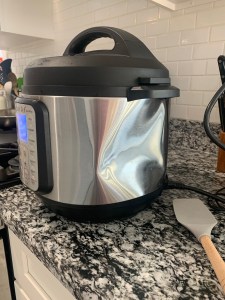
He powered it on and it turned on. He pressed the buttons so it would cook. All seemed well. He turned his back to do something else and looked back and it had gone dark. It wasn’t on. He attempted to turn it back on but nothing happened or maybe it flickered. He got so frustrated by this that he hauled off and punched the poor thing. Once punching it, he realized that the power cord wasn’t completely plugged in behind the machine itself. Upon ensuring that was fixed, it started working well and has ever since.

Dented InstaPot

I feel compelled to assure my readers that while John can be aggressive with inanimate objects, he is not with me or Eva. He also tends to control his knee jerk reactions better when we are around so we rarely witness these outbursts.

If interested, I have twice now made the following whole chicken recipe in our InstaPot and it is amazing. Juicy and tender. https://damndelicious.net/2019/01/15/instant-pot-rotisserie-chicken/